Have your own car · flexible
Castle & Gardens Admission
Skip-the-line entry with no fixed coach time — come and go within opening hours. From €24.00.
See dates and fares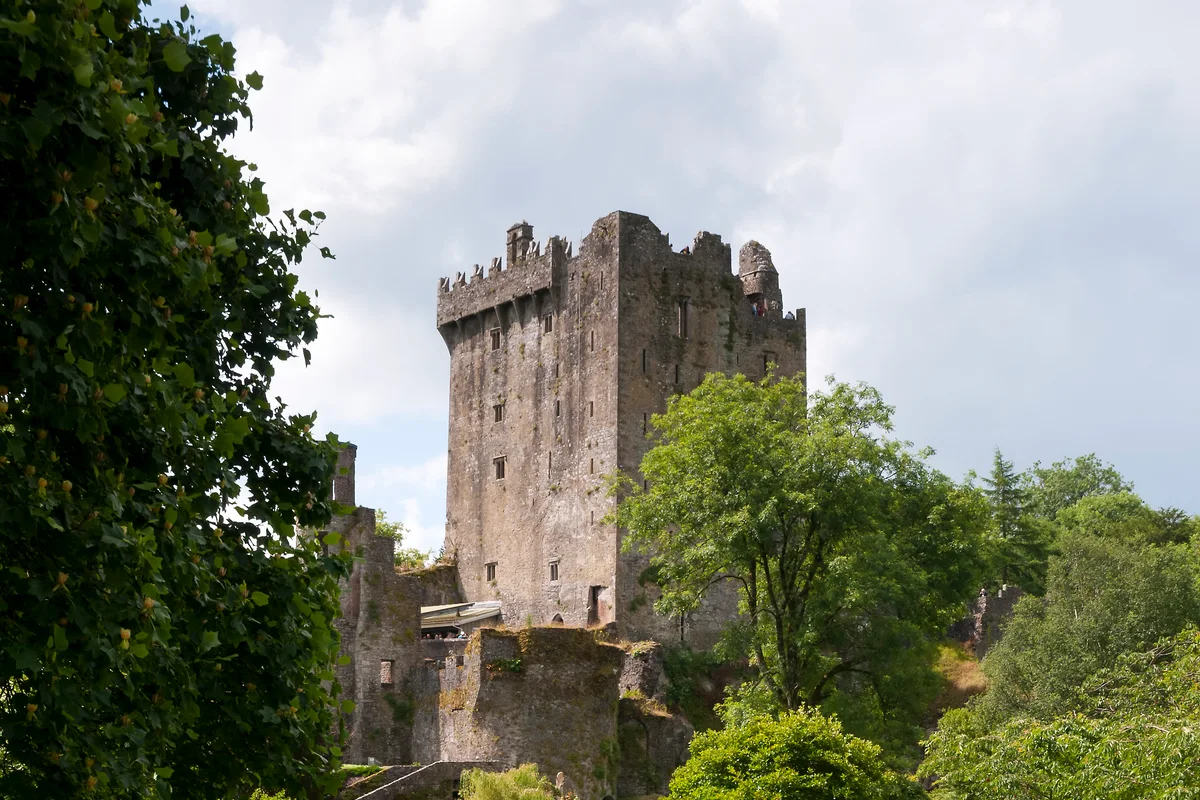
A six-hundred-year-old tower, a stone below the battlements, and a lean-back over the parapet that has drawn visitors up 127 steps for generations. Here is exactly what the climb involves, and what else is worth your time once you are up there.
In short: the Blarney Stone sits below the battlements of Blarney Castle's tower, at the top of a narrow, one-way spiral staircase of 127 steps with no lift. To kiss it, you lie on your back and lean out over the parapet edge while an attendant holds you steady behind an iron safety rail. It is not required — the climb is worth doing for the view alone — and it is not wheelchair or scooter accessible. The stone is wiped down through the day and hand sanitiser is provided at the top.
The story
Cormac 'Laidir' MacCarthy, Lord of Muskerry, built the tower that stands today in 1446, on a site that had already carried two earlier fortifications. The MacCarthys were one of the most powerful Gaelic families in Munster, and the castle was a genuine seat of power for centuries before it became a tourist attraction.
The stone itself is older again, and precisely which block became 'the' Blarney Stone has been argued about for two hundred years — there is no single settled account, only a legend that kissing it grants the 'gift of the gab': eloquence, and the confidence to talk your way out of anything. The phrase entered everyday English because of this castle, which is a fairly rare thing for a single building to have achieved.
Whatever the stone's actual origin, the ritual around it — the climb, the lean, the attendant's steadying hand — has been drawing visitors up the tower since at least the nineteenth century, and shows no sign of slowing down.
On site
Built in 1446 by Cormac 'Laidir' MacCarthy, Lord of Muskerry, on the site of two earlier fortifications. The Stone sits below the battlements at the top of 127 steps, and kissing it is said to grant the 'gift of the gab' — a legend old enough that the phrase itself entered everyday English because of it.
The oldest part of the grounds — a shaded path through ancient yew trees and natural limestone formations, some genuinely thousands of years old, others arranged into features like the Druid's Circle and the Wishing Steps by the Jefferyes family in the 1750s as a piece of eighteenth-century garden theatre.
Around seventy toxic and narcotic plants, several kept in cages for safety, each labelled with what it does and what it was once used for medicinally. One of a small handful of public poison gardens anywhere in the world, and usually the part children remember best.
A quieter, more recent addition beyond Rock Close, with a stream-fed fernery and a path around the lake. Most visitors spend as long here as they do queuing for the Stone, and a lot of first-timers do not realise it exists until they are already leaving.
Which ticket
Whether you drive yourself, come from Cork on a coach, or would rather skip the tower altogether decides which ticket actually suits you.
Have your own car · flexible
Skip-the-line entry with no fixed coach time — come and go within opening hours. From €24.00.
See dates and faresNo car needed · from Cork
The easiest way to do this without a car — a coach from Cork, admission included, and enough free time to do it properly. From €39.00.
See datesSkip the tower entirely
The grounds, properly explained — seventy toxic plants and a garden of standing stones older than the castle itself. From €32.00.
See datesBlarney Castle & Gardens is owned and operated by the Trustees of Blarney Castle. Opening hours, admission and the safety procedures at the Stone are set by them, not by any tour operator — see the schedule on your chosen tour's page for the current opening hours.
Questions
Please note: Blarney Castle Tour is an independent ticket seller. We are not a government body and we are not the operator — Blarney Castle & Gardens is run by Trustees of Blarney Castle. Photographs are real, Creative Commons–licensed images of the destinations, not taken specifically for this site; full credits are here.